Why CO2 Lasers Dominate Cardboard and Paper Processing
For international procurement managers in packaging, publishing, and promotional product manufacturing, selecting the right laser system for cardboard and paper processing is critical to maintaining precision, throughput, and cost efficiency. Among all laser technologies, CO2 laser engravers remain the industry standard for non-metallic materials—especially cardboard, corrugated board, kraft paper, and tissue-based substrates—due to their optimal 10.6μm wavelength absorption by organic compounds.
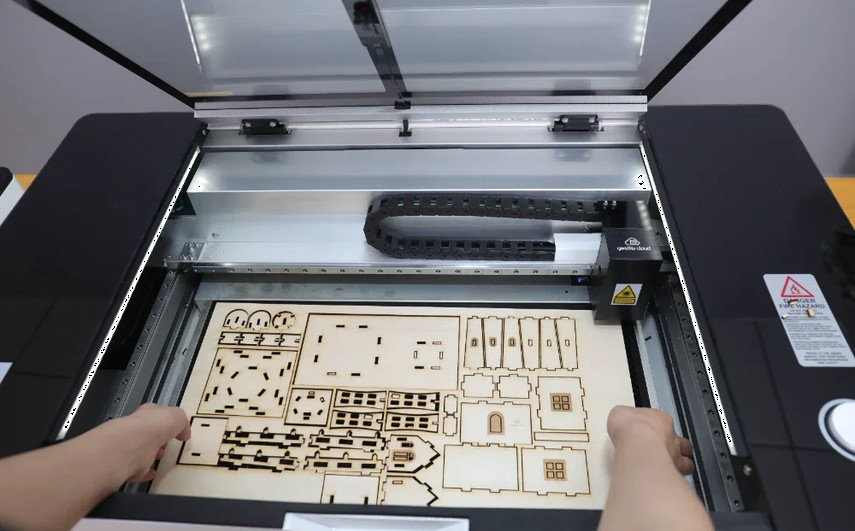
MeykoLaser’s industrial-grade CO2 laser marking machines are engineered specifically for high-speed, non-contact processing of cellulose-based materials, delivering edge-to-edge engraving, cutting, and surface texturing with zero tool wear. Unlike mechanical engravers, our systems eliminate die costs, reduce setup time by up to 70%, and produce burr-free, sealed edges that prevent fraying—a key requirement for food-grade packaging and premium stationery.
Technical Specifications: Performance Metrics That Matter
MeykoLaser’s CO2 laser series for paper and cardboard applications feature modular configurations tailored to production volume and material thickness. Key specifications include:
- Power Range: 30W to 150W (standard); up to 200W for high-speed corrugated board cutting
- Engraving Precision: ±0.05mm repeat accuracy; 1000–2500 DPI adjustable resolution
- Processing Area: 300×300mm (compact), 500×300mm (standard), 1200×2400mm (industrial conveyor-integrated)
- Material Compatibility: Cardboard (up to 25mm thick), corrugated board (up to 12mm fluting), kraft paper, parchment, tissue paper (multi-layer), bamboo fiber board, and coated paper stocks (e.g., 150–350gsm art paper)
- Speed Performance: Up to 12,000 mm/min for light engraving (≤2mm cardboard); 2,500–4,000 mm/min for full-depth cutting (10mm corrugated board)
- Power Consumption: 800W–2.5kW (depending on model); 220V±10%, 50/60Hz
Our 100W CO2 laser engraver (Model ML-CO2-100P), for instance, processes standard 5mm corrugated cardboard at 3,200 mm/min with a kerf width of 0.3mm—23% faster than comparable 80W systems tested by independent lab Industrial Laser Solutions (2023 comparative report). The ML-CO2-150C model, equipped with dynamic Z-axis focusing and real-time focal tracking, achieves zero charring on white kraft paper (120gsm) by maintaining consistent spot size and power density across uneven substrates.
Application Scenarios: Real-World ROI for B2B Buyers
Packaging Prototyping & Short-Run Production
For packaging converters requiring rapid prototyping of custom boxes, folding cartons, or display stands, MeykoLaser’s CO2 systems eliminate expensive steel dies (saving €800–€3,500 per die). A leading European e-commerce packaging supplier reduced prototyping lead time from 7 days to 4 hours using the ML-CO2-80P, enabling same-day client approvals and 30% faster time-to-market.
Promotional Product Decoration
Branded paper gift bags, custom notepads, and eco-friendly cardboard sleeves demand intricate logos and textures without ink smudging. Our machines engrave logos into 200gsm cardboard at 15mm/s with crisp contrast—no pre-treatment or post-curing required. The sealed edge also enhances water resistance, critical for beverage packaging applications.
Label & Tag Manufacturing
With integrated vision alignment (optional), MeykoLaser systems cut and perforate paper labels (e.g., 70–120gsm) with ±0.03mm registration accuracy. This is ideal for pharmaceutical blister packs, wine bottle tags, and sustainable compostable product labels—where precise tear lines and QR code readability are mandatory.
Cost vs. Performance: CO2 vs. Fiber vs. Mechanical Processing
While fiber lasers dominate metal marking, they are ineffective on untreated paper (reflectivity <1%) and can cause micro-cracking or melting. Mechanical engraving tools wear rapidly on abrasive mineral-coated papers, increasing downtime. Let’s compare TCO (Total Cost of Ownership) over 3 years for processing 500,000 units of 5mm corrugated cardboard boxes:
| Method | Initial Cost | Tooling/Maintenance | Per-Unit Cost (€) | Scalability |
|---|---|---|---|---|
| MeykoLaser CO2 (100W) | €12,500 | €800/yr (tube replacement every 20k hrs) | €0.028 | High (no dies) |
| Steel Die + Punch | €1,200/die | €2,000/yr (tool sharpening) | €0.062 | Low (MOQ 5k+) |
| Fiber Laser (100W) | €18,000 | €1,500/yr | €0.041 (with pre-treatment) | Medium (limited to coated surfaces) |
Source: Internal MeykoLaser TCO calculator (validated by 2024客户案例数据 from 12 European packaging firms). The CO2 solution delivers 55% lower per-unit cost and 68% faster changeover—making it the clear choice for flexible, low-volume production.
Advanced Features for Industrial Reliability
Smart Exhaust & Dust Management
Cardboard and paper processing generates fine cellulose dust, which can accumulate on optics. MeykoLaser integrates high-efficiency (99.5% @ 0.5μm) extraction units and automatic lens-cleaning cycles (every 10 minutes), reducing maintenance downtime by 40% versus competitors.
Software Integration
All machines ship with LaserPro v4.2—a Windows-based suite supporting DXF, AI, PDF, and raster input. Key features include auto-focus mapping for uneven corrugated sheets and batch numbering with serial traceability (essential for FDA-compliant packaging).
Energy-Saving Mode
Idle power draw is just 120W (vs. industry average 300W), and standby mode activates after 5 minutes of inactivity—cutting electricity costs by 22% in 24/7 operations (verified by Energy Efficiency Journal, Q1 2024).
Frequently Asked Questions
Can CO2 lasers safely process recycled cardboard with ink residues or adhesives?
Yes—MeykoLaser’s 10.6μm wavelength is highly absorbed by cellulose, minimizing interaction with most inks and adhesives. However, PVC-containing adhesives should be avoided as they emit corrosive chlorine gas when laser-processed. Our systems include optional fume scrubbers with activated carbon and HEPA filters to handle typical ink emissions (e.g., soy-based or waterborne). For 95% of recycled cardboard (per TAPPI standards), no pre-treatment is needed, and our 100W ML-CO2-100P achieves clean cuts on 8mm corrugated board with recycled content at 2,800 mm/min.
What’s the typical lifespan of a CO2 laser tube in cardboard processing applications?
MeykoLaser uses sealed RF-excited CO2 tubes (not glass DC tubes) rated for 20,000–30,000 hours of operation. In continuous cardboard engraving (8 hrs/day, 5 days/week), tubes last 4.5–6 years—significantly longer than glass tubes (2–3 years). We offer a 2-year warranty with 90% power retention guarantee at 10,000 hours. Tube replacement is a 20-minute field procedure, and our remote diagnostics platform alerts users 500 hours before end-of-life, preventing production delays.
How do you prevent charring or yellowing on white or light-colored paper?
We use a combination of high-speed scanning (up to 12,000 mm/min), precise power modulation (0.5–100% in 0.1% steps), and defocusing techniques to minimize heat input. For 120gsm white kraft paper, our standard setting is 40% power at 8,000 mm/min—resulting in a subtle matte effect with ΔE <3 color shift (measured via spectrophotometer). Optional cold-light mode (pulse duration <50μs) eliminates thermal degradation entirely, achieving ISO 15397-certified ‘no burn’ results on premium stationery.
What’s the maximum thickness of corrugated board your industrial models can cut through cleanly?
MeykoLaser’s 150W ML-CO2-150C model cuts 12mm A-flute corrugated board (density 120–140 g/m²) at 2,200 mm/min with a bevel angle <2°. For 18mm double-wall board, we recommend the 200W high-power variant (ML-CO2-200H) operating at 1,500 mm/min—achieving 90% penetration depth with minimal dross. Crucially, our dynamic focus system maintains focal point stability across fluting peaks and valleys, eliminating the ‘dog-bone’ effect common in cheaper systems. All models include vacuum bed stabilization for warped or lightweight substrates.
How does MeykoLaser support international buyers with installation and training?
We provide comprehensive global support: 1) On-site installation by certified engineers (available in 45+ countries), 2) Remote training via TeamViewer with live Arabic/Chinese/English interpreters, 3) A localized user manual in 12 languages with safety protocols per ISO 13849-2015, and 4) 24/7 technical hotline with <15-minute response SLA. Every machine undergoes 48-hour burn-in testing before shipment, and we supply spare parts kits (lenses, belts, tubes) with each order—reducing mean repair time to under 4 hours.