
Introduction to CO2 Engraving Machine Price Considerations
When evaluating the co2 engraving machine price, procurement managers must look beyond the sticker tag and consider the total value delivered over the machine’s lifecycle. A CO2 laser marking system is a capital investment that influences production throughput, part quality, and operational expenses. Understanding the variables that drive price helps buyers align specifications with budget while securing a solution that meets both current and future marking demands.
Key Factors Influencing CO2 Engraving Machine Price
Laser Power and Source
The laser tube power is the primary determinant of the co2 engraving machine price. Entry‑level 30 W sealed CO2 tubes typically start around USD 3,200, while a 60 W unit rises to roughly USD 5,500. High‑power 100 W and 150 W sources push the base cost to USD 8,000–USD 12,000. The price increase is not linear; each additional watt adds diminishing returns in speed but significantly expands the range of compatible materials and marking depth.
Working Area and Beam Quality
Larger marking fields require bigger galvo mirrors and more robust cooling systems, adding to the co2 engraving machine price. A standard 110 × 110 mm field adds little cost, but expanding to 200 × 200 mm can increase the price by 15‑20 %. Beam quality (M² factor) also matters; a lower M² (<1.2) enables finer details and higher speeds, often justifying a premium of USD 500–USD 1,000 over a basic configuration.
Software and Control System
Proprietary marking software with advanced features such as vector tracing, bitmap grayscale, and real‑time monitoring adds value. MeykoLaser’s EZMark suite, included in all models, provides CAD/CAM integration and barcode generation. Systems that offer third‑party software compatibility or SDK access may cost an extra USD 300–USD 800, reflecting development and licensing expenses.
Build Quality and Components
The frame material, linear guide quality, and ventilation system affect durability and price. Machines built with welded steel frames and industrial‑grade linear rails cost more than aluminum‑extruded equivalents but deliver longer service life and higher precision. Expect a price differential of USD 400–USD 700 for a heavy‑duty chassis versus a lightweight version.
MeykoLaser CO2 Laser Marking Machine Portfolio
Entry‑Level 30W Model (ML‑CO2‑30)
The ML‑CO2‑30 is designed for small workshops and prototyping labs. Specifications include a 30 W sealed CO2 tube, 110 × 110 mm marking area, maximum speed 3,500 mm/s, positioning accuracy ±0.02 mm, and a working temperature range of 5 °C–40 °C. The base co2 engraving machine price is USD 3,250. Optional upgrades such as a rotary axis add USD 450, while an upgraded fume extraction system costs USD 300.
Mid‑Range 60W and 100W Units (ML‑CO2‑60 / ML‑CO2‑100)
These models target mid‑volume production. The ML‑CO2‑60 offers a 60 W tube, 150 × 150 mm field, speed up to 5,000 mm/s, and accuracy ±0.015 mm. Its price starts at USD 5,600. The ML‑CO2‑100 steps up to a 100 W tube, 200 × 200 mm area, speed 6,500 mm/s, and accuracy ±0.01 mm, with a base price of USD 8,200. Both units include the EZMark software suite, water‑cooling chiller, and safety interlocks as standard.
High‑Power 150W Industrial System (ML‑CO2‑150)
For heavy‑duty marking on thick acrylics, wood, and stone, the ML‑CO2‑150 delivers 150 W output, a 300 × 300 mm marking area, speed 7,500 mm/s, and accuracy ±0.008 mm. The system features a dual‑stage galvo, industrial chiller, and optional conveyor integration. The co2 engraving machine price for this configuration begins at USD 11,900, with additional accessories like a vision alignment system adding USD 1,200.
Application Scenarios and Material Compatibility
Non‑Metallic Materials
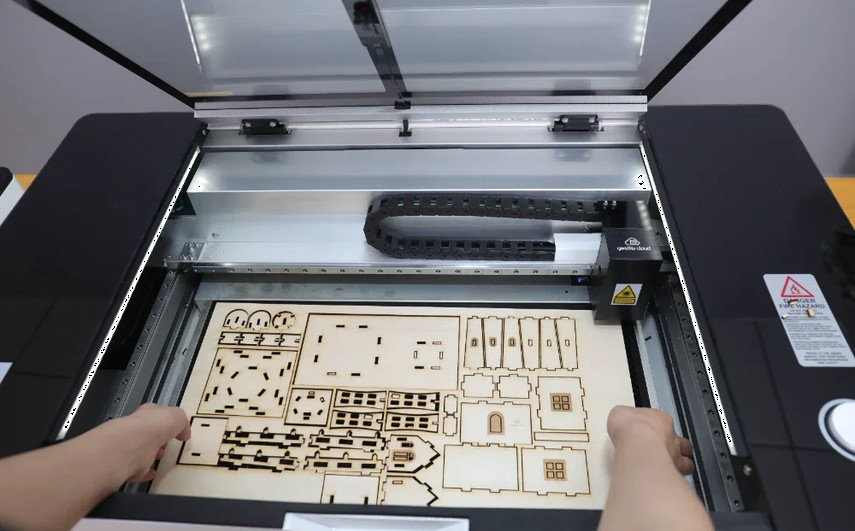
CO2 lasers excel at marking organic substrates. Typical applications include laser engraving on wood (birch, MDF, plywood) at depths of 0.1–0.5 mm, acrylic cutting and etching up to 12 mm thick, leather personalization, glass surface marking, and paper/cardboard scoring. The co2 engraving machine price is justified by the ability to replace mechanical tools, reducing consumable waste and setup time.
Marking on Metals with CO2 (via Pretreatment)
While CO2 wavelengths are poorly absorbed by bare metals, a thin coating of marking spray or laser‑absorbent paste enables high‑contrast marks on stainless steel, aluminum, and brass. This pretreatment method adds minimal cost (approx. USD 0.02 per part) and allows the same machine to serve both non‑metal and metal marking lines, improving ROI.
Industry‑Specific Use Cases
In the packaging sector, CO2 lasers create QR codes and lot numbers on cartons at speeds exceeding 10,000 pcs/h. The automotive interior trim market uses them for logo engraving on dashboards and door panels. Medical device manufacturers rely on CO2 marking for sterilizable trays and instrument housings, where legibility and resistance to cleaning agents are critical. Each vertical benefits from the precise control offered by MeykoLaser’s galvo systems, which translates the co2 engraving machine price into lower scrap rates and higher traceability compliance.
Price Comparison: MeykoLaser vs. Market Averages
Cost‑Per‑Watt Analysis
Industry data shows an average cost‑per‑watt for CO2 laser markers of USD 90–USD 110. MeykoLaser’s ML‑CO2‑60 sits at USD 93/W, the ML‑CO2‑100 at USD 82/W, and the ML‑CO2‑150 at USD 79/W, reflecting economies of scale in larger tubes. Competitors with similar specifications often list prices 10‑18 % higher due to brand premiums or proprietary software fees.
Total Cost of Ownership (TCO)
Beyond the upfront co2 engraving machine price, TCO includes electricity, maintenance, and consumables. A 60 W unit consumes approximately 0.6 kW during marking, translating to roughly USD 0.07 per hour at an industrial electricity rate of USD 0.12/kWh. Annual maintenance (tube replacement every 18–24 months, lens cleaning) averages USD 350. Over a five‑year horizon, the TCO for the ML‑CO2‑60 is estimated at USD 7,200, which is 12 % lower than the average competitor TCO of USD 8,200 for comparable power.
How to Choose the Right CO2 Engraving Machine for Your Budget
Define Your Marking Requirements
Start by detailing the material types, marking depth, contrast needs, and throughput. For shallow surface etching on wood or leather, a 30 W system may suffice, keeping the co2 engraving machine price under USD 4,000 with accessories. For deeper engraving or cutting acrylics above 6 mm, consider at least 60 W to avoid multiple passes that increase cycle time.
Evaluate Production Volume
Calculate expected parts per shift. If the target is below 500 pcs/day, the entry‑level model offers the best cost‑benefit. Volumes between 500–2,000 pcs/day align well with the 60 W or 100 W units, where the increased speed reduces labor cost per part. For continuous line operations exceeding 2,000 pcs/day, the 150 W system’s higher duty cycle and optional conveyor integration justify the higher upfront co2 engraving machine price.
Consider Future Scalability
Investing in a platform with modular accessories (rotary axis, vision system, conveyor) protects against obsolescence. MeykoLaser’s machines are designed with standard mounting points and software hooks, allowing upgrades without replacing the core laser source. This flexibility can reduce long‑term capital expenditure by 20‑30 % compared to purchasing a new machine when requirements evolve.
Future Trends Impacting CO2 Engraving Machine Price
Three trends are shaping the co2 engraving machine price landscape: (1) Advances in RF‑excited CO2 tubes are increasing efficiency and lifespan, potentially lowering the cost‑per‑watt by 5‑8 % over the next three years. (2) Integration of AI‑driven process monitoring is becoming standard, adding a modest software premium but reducing waste and rework. (3) The push for greener manufacturing is driving demand for units with low‑ozone emissions and energy‑saving standby modes, which may command a slight price premium but deliver savings in facility compliance costs. Staying informed helps procurement managers time purchases to capture the best value.
Conclusion and Call‑to‑Action
Understanding the co2 engraving machine price requires a holistic view that balances laser power, working area, software, build quality, and total cost of ownership. MeykoLaser’s CO2 laser marking lineup delivers competitive cost‑per‑watt, robust performance, and scalable options tailored to diverse industrial applications. By aligning specifications with production needs and factoring in future growth, buyers can secure a solution that maximizes ROI while maintaining high marking quality.
Ready to discuss your specific requirements and receive a detailed quotation? Contact MeykoLaser sales today to speak with an application engineer who can configure the optimal CO2 engraving machine for your budget and production goals.
Frequently Asked Questions
What is the typical price range for a MeykoLaser CO2 engraving machine?
MeykoLaser offers CO2 laser marking machines across several power levels. The entry‑level 30 W model starts at approximately USD 3,250, while the 60 W mid‑range unit is priced around USD 5,600. The 100 W system begins near USD 8,200, and the high‑power 150 W industrial configuration starts at about USD 11,900. These base prices include the laser tube, galvo scanner, EZMark software, standard cooling, and safety interlocks. Optional accessories such as rotary axes, vision alignment, or conveyor integration add extra costs ranging from USD 300 to USD 1,200 depending on the configuration. Overall, the co2 engraving machine price scales with power, marking field, and added features, providing flexible options for different budgets.
How does laser power affect the co2 engraving machine price and marking capability?
Laser power is the primary driver of the co2 engraving machine price because higher‑watt CO2 tubes are more expensive to manufacture and require stronger cooling and power supplies. A 30 W tube enables shallow engraving on wood, leather, and thin acrylics, suitable for low‑volume prototyping. Increasing to 60 W roughly doubles the engraving speed and allows cutting of acrylics up to 8 mm thick with fewer passes. At 100 W, users gain the ability to mark thicker woods and perform faster deep engraving, while the 150 W system can cut through 12 mm acrylic and engrave metals with pretreatment. Although the price increase is not linear—each additional watt adds diminishing returns in speed—the expanded material compatibility and throughput often justify the higher investment for production environments.
What materials can be processed with a MeykoLaser CO2 laser marking machine?
MeykoLaser CO2 lasers are ideal for non‑metallic substrates. Common materials include various woods (hardwood, plywood, MDF), acrylics (up to 12 mm thickness depending on power), leather, textiles, glass, stone, ceramics, paper, cardboard, and certain plastics like ABS and polycarbonate. For metals, a bare CO2 beam is poorly absorbed, but applying a laser‑absorbent marking spray or paste enables high‑contrast marks on stainless steel, aluminum, brass, and coated steel. This versatility allows a single machine to serve multiple production lines, improving the overall value of the co2 engraving machine price by reducing the need for separate equipment.
What is the expected total cost of ownership (TCO) for a MeykoLaser CO2 engraving machine over five years?
The TCO comprises the initial purchase price, electricity consumption, maintenance, and consumables. For a typical 60 W unit operating two shifts daily, power draw averages 0.6 kW, costing roughly USD 0.07 per hour at an industrial rate of USD 0.12/kWh. Annual electricity expense is therefore about USD 120. Maintenance includes CO2 tube replacement every 18–24 months (approx. USD 300) and periodic lens/mirror cleaning (USD 50/year). Over five years, these recurring costs total around USD 750. Adding the base price of USD 5,600 gives an estimated five‑year TCO of approximately USD 6,350. Compared with industry averages where similar‑spec machines exhibit a TCO of USD 7,200–USD 8,000, MeykoLaser’s offering delivers a noticeable cost advantage while maintaining high performance.
How can I determine the right CO2 engraving machine model for my production needs?
Begin by mapping your marking requirements: material type, desired depth or contrast, required throughput, and part size. For low‑volume marking of thin organics, the 30 W ML‑CO2‑30 provides sufficient capability at the lowest co2 engraving machine price. If you need to cut acrylic up to 8 mm or increase marking speed for medium volumes (500–2,000 pcs/day), the 60 W or 100 W models offer the best balance of price and performance. High‑volume lines exceeding 2,000 pcs/day or applications demanding deep engraving on thick substrates benefit from the 150 W ML‑CO2‑150, especially when paired with optional conveyors or vision systems. Finally, consider future scalability—investing in a platform with modular accessories protects against obsolescence and can reduce long‑term capital expenditure by up to 30 %.