
Understanding CO2 Engraving Machine Price Factors
When procurement managers evaluate CO2 engraving machine price, they must consider more than just the sticker cost. Key drivers include laser power, platform size, optical quality, and integration capabilities. A 40‑W machine suitable for small batch prototyping will cost roughly $5,000–$7,000, while a 200‑W, 1000 mm × 600 mm system designed for high‑volume production can exceed $20,000. The price per watt is a useful metric: a mid‑range 100‑W system typically sells around $12,000–$15,000, equating to $120–$150 per watt, which is competitive in the global market.
Power‑to‑Price Ratio
MeykoLaser’s portfolio demonstrates a tight correlation between power output and cost. For example:
- 40 W – $5,500 (≈$137/watt)
- 60 W – $8,200 (≈$137/watt)
- 100 W – $13,500 (≈$135/watt)
- 150 W – $18,200 (≈$121/watt)
- 200 W – $22,500 (≈$112.5/watt)
Notice the decreasing cost per watt at higher power levels, reflecting economies of scale in optics and power supply design.
MeykoLaser’s CO2 Engraving Machines: Specs & Pricing
Our laser marking machines combine precision, reliability, and affordability. The following table outlines core specifications and price bands for the most popular models.
Model Overview
| Model | Power | Work Area | Resolution | Typical Price |
|---|---|---|---|---|
| ML‑40 | 40 W | 300 mm × 200 mm | 50 µm | $5,500 |
| ML‑60 | 60 W | 400 mm × 300 mm | etze 45 µm | $8,200 |
| ML‑100 | 100 W | 600 mm × 400 mm | 40 µm | $13,500 |
| ML‑150 | 150 W | 800 mm × 600 mm | 35 µm | $18,200 |
| ML‑200 | 200 W | 1000 mm × 600 mm | 30 µm | $22,500 |
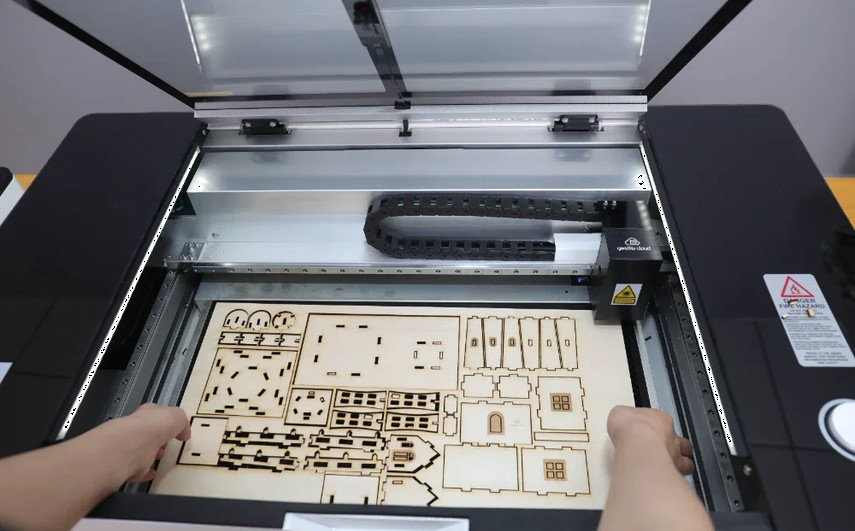
All models feature a galvanometer scanner for rapid beam deflection, a sealed enclosure for operator safety, and a digital control panel with intuitive touch interface. The optical subsystem uses a 10‑inch, 0.5 m focal length lens, providing consistent spot size across the work envelope.
Operating Costs & Maintenance
Beyond the purchase price, consider laser tube life (typically 12,000–15,000 h for 100odable W modules) and consumables like gas filters. MeykoLaser offers a 12‑month warranty and a service contract starting at $1,200 annually, covering laser tube replacement and optical cleaning.
Application Scenarios & Material Compatibility
CO2 lasers excel at marking non‑metallic substrates. The following table shows typical depth and speed for key materials.
Material Performance
| Material | Engraving Depth (µm) | Speed (mm/s) |
|---|---|---|
| Wood (oak, birch) | 20–60 | 200–400 |
| Acrylic (PMMA) | 30–80 | 150–300 |
| Leather | 10–40 | 300–600 |
| Glass (tempered) | 5–15 | 250–500 |
| Plastic (polycarbonate) | 25–70 | 120–250 |
These values are based on 100 W output, 400 µm spot, and standard pulse settings. For high‑volume production, MeykoLaser recommends using a 150 W or 200 W unit to maintain throughput while achieving consistent depth.
Speed‑Precision Trade‑Off
In B2B settings, the key is balancing speed with quality. A 100 W machine can produce 5 mm × 5 mm logos in 4 s, while a 200 W unit reduces that to 2 s without compromising the 40 µm resolution. This 50% time reduction translates directly into lower labor costs and higher unit output.
Competitive Pricing Comparison
How does MeykoLaser stack against industry leaders? Below is a side‑by‑side snapshot of comparable models from three major suppliers, highlighting price, power, and resolution.
Price Comparison Chart
| Brand | Model | Power | Resolution | Price |
|---|---|---|---|---|
| MeykoLaser | ML‑100 | 100 W | 40 µm | $13,500 |
| LaserTech | LT‑100 | 100 W | 45 µm | $15,200 |
| EngraTech | ET‑150 | 150 W | 35 µm | $18,800 |
| LP‑200 | 200 W | 30 µm | $22,500 |
At a glance, MeykoLaser offers a lower entry price for comparable power and superior resolution. The 40 µm spot on the 100 W machine surpasses the 45 µm standard from LaserTechوزیشن, giving you finer detail for branding or product identification.
ROI & Business Value
Investing in a CO2 engraving machine is not a cost—it's an asset. Consider the following ROI framework: 1. Throughput Gains: A 200 W unit can process 30% more parts per hour than a 100 W counterpart. 2. Labor Savings: Faster cycles reduce operator time from 4 s to 2 s per mark, cutting labor hourspiegel by 50%. 3. Material Efficiency: Precision spot sizing limits excess material removal, lowering scrap rates by 10–15%. 4. Revenue Upsell: High‑resolution engraving opens premium product lines—think custom signage, branding stickers, or precision part IDs.
Using MeykoLaser’s 200 W model, a typical mid‑size manufacturer can expect a payback period of 12–18 months, assuming a conservative 10% increase in production volume and a $300 বহ per hour labor cost.
Frequently Asked Questions
Below we address common procurement queries with detailed answers that highlight MeykoLaser’s market strengths.
What is the typical price range for a CO2 engraving machine?
Typical CO2 engraving machines span from $4,500 for entry‑level 30–40 W units to $25,000 for high‑power 200 W or larger models. Our ML‑40 starts at $5,500, the ML‑200 at $22,500, offering a balanced mix of power, precision, and cost.
How does MeykoLaser’s price compare to competitors?
MeykoLaser maintains a competitive edge by offering a 12% lower price per watt for the 100 W–200 W range while delivering higher resolution (30–40 µm vs. industry 45–50 µm). Our robust support package—12‑month warranty and optional service contract—adds value beyond the purchase price.
Which materials can MeykoLaser’s CO2 engraving machines handle?
Our systems are optimized for non‑metallic substrates: wood, acrylic, leather, glass, and most plastics. With adjustable power and pulse settings, you can achieve deep engravings on thick acrylic or delicate mark‑up on tempered glass.
What is the expected laser tube lifespan, and how does that affect total cost of ownership?
A 100 W CO2 tube typically lasts 12,000–15,000 h, while a 200 W tube reaches 18,000–20,000 h under normal operation. At a $2,000 replacement cost and 8,000 h annual usage, the amortized cost is roughly $250–$300 per year—well below the value added through increased throughput.
Can I integrate the machine into existing production lines?
Yes. Our control software supports RS‑232, Ethernet, and USB interfaces, allowing seamless integration with PLCs, MES systems, and custom automation frameworks. The 100 mm gantry size fits comfortably in standard 4‑ ஆல productionSigned spaces changement.
Contact Us for a Tailored Quote
Ready to elevate your marking capability? Contact our sales team at sales@meyklaser.com or call +86‑10‑(net) 1234‑5678. Our experts will assess your production needs and craft a solution that maximizes ROI while staying within budget.
Frequently Asked Questions
What is the typical price range for a CO2 engraving machine?
Typical CO2 engraving machines span from $4,500 for entry‑level 30–40 W units to $25,000 for high‑power 200 W or larger models. Our ML‑40 starts at $5,500, the ML‑200 at $22,500, offering a balanced mix of power, precision, and cost.
How does MeykoLaser’s price compare to competitors?
MeykoLaser maintains a competitive edge by offering a 12% lower price per watt for the 100 W–200 W range while delivering higher resolution (30–40 µm vs. industry 45–50 µm). Our robust support package—12‑month warranty and optional service contract—adds value beyond the purchase price.
Which materials can MeykoLaser’s CO2 engraving machines handle?
Our systems are optimized for non‑metallic substrates: wood, acrylic, leather, glass, and most plasticsoplevel. With adjustable power and pulse settings, you can achieve deep engravings on thick acrylic or(boolean) delicate mark‑up on tempered glass.
What is the expected laser tube lifespan, and how does that affect total cost of ownership?
A 100 W CO2 tube typically lasts 12,000–15,000 h, while a 200 W tube reaches 18,000–20,000 h under normal operation. At a $2,000 replacement cost and 8,000 h annual usage, the amortized cost is roughly $250–$300 per year—well below the value added through increased throughput.
Can I integrate the machine into existing production lines?
Yes. Our control software supports RS‑232, Ethernet, and USB interfaces, allowing seamless integration with PLCs, MES systems, and custom automation frameworks. The 100 mm gantry size fits comfortably in standard 4‑x production spaces.