
Understanding the True Cost of CO2 Engraving Machines in 2024
For procurement managers and manufacturing directors, the CO2 engraving machine price is rarely just a single line item in a budget. It represents a significant capital expenditure that impacts your total cost of ownership (TCO), production efficiency, and long-term profitability. While entry-level units may appear attractive at first glance, the industrial-grade equipment required for high-volume manufacturing environments operates on a different economic model. At MeykoLaser, we help international B2B buyers navigate this complex pricing landscape by focusing on value, durability, and operational efficiency rather than just the upfront sticker price.
The global market for laser marking and engraving equipment has seen a shift in pricing structures due to advancements in laser source technology and increased demand for automation integration. Understanding the factors that drive these costs is essential for making an informed purchasing decision. This guide breaks down the variables influencing CO2 engraving machine price, compares key specifications, and demonstrates how investing in high-quality industrial systems like those from MeykoLaser delivers superior ROI compared to cheaper, less reliable alternatives.
Key Factors Influencing CO2 Engraving Machine Pricing
When evaluating quotes from various suppliers, it is crucial to understand why two machines with similar appearances can have vastly different price tags. The primary drivers of cost include laser source type, power output, motion system precision, and software capabilities.
Laser Source Technology and Lifespan
The heart of any CO2 system is the laser source. Traditional glass tube lasers are cheaper upfront but require frequent replacement and maintenance, driving up operational costs. In contrast, metal RF (Radio Frequency) tube lasers, such as those used in MeykoLaser’s premium series, offer a lifespan exceeding 20,000 hours with consistent beam quality. While the initial investment in an RF source is higher, the reduction in downtime and consumable costs results in a lower TCO over a five-year period. Buyers should calculate the annual replacement cost of glass tubes against the extended warranty and stability of metal RF systems to see the true financial benefit.
Power Output and Processing Speed
Power ratings directly correlate with processing speed and the ability to handle thicker materials. A 30W CO2 laser is suitable for delicate engraving on thin acrylics or wood, while a 100W to 130W system is necessary for deep engraving on hard woods, acrylics up to 20mm, and certain metals with marking coatings. Higher power systems command a higher CO2 engraving machine price due to the increased energy consumption and more robust cooling systems required. However, the throughput increase often justifies the cost for high-volume production lines.
Precision and Motion Control Systems
The accuracy of the galvanometer scanner and the stability of the rotary axis significantly impact the final product quality. High-precision F-theta lenses and servo motors ensure repeatability within 0.01mm, which is critical for medical device marking and electronics components. Cheaper machines often use stepper motors and lower-grade optics, leading to drift and inconsistent results over time. MeykoLaser integrates high-end components to ensure that your precision requirements are met consistently, reducing scrap rates and material waste.
Application Scenarios and Material Compatibility
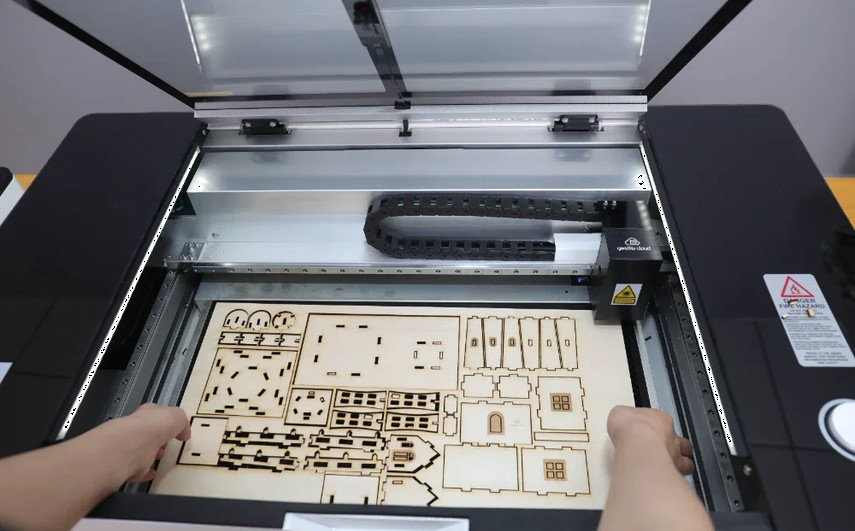
Selecting the right machine depends heavily on the materials you intend to process. CO2 lasers are non-metallic specialists, interacting primarily with organic materials and plastics. Understanding these compatibility parameters helps you avoid purchasing underpowered or overqualified equipment.
- Acrylic and Plastics: CO2 lasers excel here, producing clean, polished edges on acrylic without post-processing. Power ranges from 40W to 80W are ideal for standard signage and display manufacturing.
- Wood and Bamboo: For deep engraving on hardwoods like maple or oak, higher power (100W+) is recommended to achieve depth without excessive pass times. Softwoods can be processed with 30W-50W units.
- Leather and Textiles: Low to medium power (30W-60W) is sufficient for cutting patterns and engraving logos on leather goods, offering high precision and minimal edge burning.
- Paper and Cardboard: High-speed cutting of packaging materials requires stable power delivery to prevent charring. MeykoLaser’s automated feeding systems enhance efficiency for packaging converters.
Comparing Price Ranges: Entry-Level vs. Industrial Grade
To provide clarity, we have analyzed current market data for industrial CO2 engraving machines. These ranges are estimates based on configuration and region, but they provide a benchmark for negotiation and budgeting.
| Machine Type | Power Range | Estimated Price Range (USD) | Best For |
|---|---|---|---|
| Entry-Level Desktop | 30W - 50W | $2,500 - $4,500 | Small workshops, prototyping, low-volume crafts |
| Standard Industrial | 60W - 80W | $5,000 - $9,000 | Signage shops, custom packaging, medium production |
| High-Power Industrial | 100W - 130W | $10,000 - $18,000 | High-speed cutting, thick materials, 24/7 operation |
| Automation Integrated | 80W - 130W + Robot | $25,000+ | Mass production, unattended operation, logistics |
Notice that the jump from standard industrial to high-power automated systems represents a significant investment. However, when factoring in labor savings, increased throughput, and reduced error rates, the payback period for MeykoLaser’s automated solutions is often under 18 months for high-volume manufacturers.
Why Choose MeykoLaser for Your CO2 Engraving Needs?
MeykoLaser distinguishes itself by offering transparent pricing and superior engineering. We do not compromise on core components to lower the CO2 engraving machine price. Our machines are built with international-standard components, including Raycus or IPG sources (where applicable for hybrid systems) and high-precision galvanometers, ensuring compatibility with global supply chains.
Our after-sales service is another critical differentiator. We provide comprehensive training, remote troubleshooting, and rapid spare parts shipping for international clients. This support structure minimizes downtime, which is the hidden cost that often erodes the savings from cheaper initial purchases. By choosing MeykoLaser, you are investing in a partner dedicated to your long-term production success.
Call to Action: Get a Customized Quote
Ready to optimize your production line? Contact our sales team today for a detailed consultation. We will analyze your specific material requirements and volume needs to recommend the optimal CO2 engraving machine configuration. Visit http://www.meyko.cn to explore our full catalog or request a free demo video.
Frequently Asked Questions
What is the average price range for an industrial CO2 engraving machine?
The price for an industrial CO2 engraving machine typically ranges from $5,000 to $18,000 USD, depending on power output and features. Entry-level 30W-50W units start around $2,500, while high-power 100W-130W systems with automation can exceed $25,000. MeykoLaser offers competitive pricing within these ranges, ensuring you get industrial-grade durability without the premium markups of major western brands.
Does a higher CO2 laser power always mean a better price investment?
Not necessarily. Higher power (e.g., 130W vs. 60W) is only beneficial if you need to cut thick materials or require faster throughput. For thin acrylics or surface engraving, a 30W-50W machine is more cost-effective and energy-efficient. MeykoLaser’s technical team helps you calculate the exact power needed for your specific applications to avoid overpaying for unused capacity.
How does the maintenance cost affect the total cost of ownership?
Maintenance is a significant hidden cost. Glass tube lasers require replacement every 1,000-2,000 hours, whereas metal RF tubes last 20,000+ hours. When calculating the CO2 engraving machine price, factor in these consumables. MeykoLaser’s systems are designed for low maintenance, reducing annual servicing costs by up to 60% compared to traditional glass tube systems, leading to faster ROI.
Can I integrate a CO2 engraving machine into an existing production line?
Yes, MeykoLaser offers customizable solutions for automation integration. We provide rotary axes, conveyor systems, and robotic loading/unloading options that can be integrated with your existing workflow. This scalability allows you to start with a standalone unit and expand into full automation as your production volume grows, protecting your initial investment.
What warranty and support does MeykoLaser provide for international buyers?
MeykoLaser provides a comprehensive 2-year warranty on core components and lifetime technical support. We offer remote diagnostic services, video training, and expedited shipping for spare parts to minimize downtime. Our international support team is available 24/7 to assist with installation and troubleshooting, ensuring your operations run smoothly regardless of your location.