
Why CO2 Laser Technology Remains the Industry Standard for Non-Metal Processing
In the evolving landscape of industrial manufacturing, selecting the right CO2 engraving machine price is not merely a cost-saving exercise but a strategic investment in production efficiency. While fiber lasers dominate metal processing, CO2 (Carbon Dioxide) lasers remain the undisputed kings of non-metal applications. For procurement managers overseeing packaging, signage, acrylic fabrication, and textile industries, understanding the nuanced pricing structures is critical to optimizing capital expenditure without compromising on precision or durability.
Unlike solid-state lasers that rely on diode pumping, CO2 lasers generate light through a gas mixture of carbon dioxide, nitrogen, and helium. This fundamental difference results in a beam that is highly absorbed by organic materials and plastics, making it uniquely suited for engraving, cutting, and marking tasks that fiber lasers cannot perform effectively. As global supply chains demand faster turnaround times and higher customization, the demand for reliable CO2 systems from reputable manufacturers like MeykoLaser has surged.
Decoding the CO2 Engraving Machine Price: Key Cost Drivers
When evaluating a CO2 engraving machine price, buyers often encounter a wide variance, ranging from $3,000 for entry-level desktop units to over $25,000 for high-power, large-format industrial systems. This disparity is driven by several technical factors that directly impact long-term operational costs and output quality. Understanding these variables allows procurement teams to negotiate better and select equipment that aligns with specific throughput requirements.
Laser Source and Power Output
The heart of the machine is the laser tube, and its power rating is the primary determinant of cost. Power ranges typically span from 60W to 200W+ for industrial applications. A 60W tube is sufficient for light engraving on thin acrylics or wood, whereas a 130W to 150W tube is required for deep engraving and rapid cutting of thicker materials. MeykoLaser utilizes high-efficiency RF or DC sealed CO2 tubes that offer a lifespan exceeding 10,000 hours, reducing the total cost of ownership compared to cheaper, short-lived alternatives. Higher power correlates with a higher initial price but significantly reduces cycle times, offering a faster return on investment for high-volume production environments.
Work Area and Mechanical Precision
The size of the working area dictates the scale of projects you can undertake. Standard industrial beds range from 600x900mm to 1300x900mm. Larger formats command a premium due to the increased material costs for the gantry and the need for more robust linear guides. Precision is another critical cost factor. Machines equipped with high-resolution linear rails and ball screws ensure micron-level accuracy, which is essential for intricate logos on luxury goods. MeykoLaser integrates advanced motion control systems that maintain consistency across the entire bed, ensuring that the first piece produced is identical to the thousandth.
Software and Automation Features
Modern CO2 engraving machine price structures often include value-added software packages and automation features. RAYLASE galvo systems, for instance, offer significantly faster marking speeds than traditional flying optics but come at a higher price point. Additionally, rotary attachments for cylindrical objects, auto-focus sensors, and camera positioning systems add to the upfront cost but drastically reduce setup time and material waste. For B2B buyers, these features are not luxuries but necessities for integrating laser processing into automated production lines.
Application Scenarios and Material Compatibility Analysis
To justify the CO2 engraving machine price, it is essential to map the equipment to specific high-value applications. CO2 lasers are particularly effective on materials with high carbon content or those that absorb infrared wavelengths well. Below is a comparative analysis of common applications and the recommended machine specifications.
Acrylic and Plastic Fabrication
Acrylic (PMMA) is one of the most popular materials for CO2 lasers. The laser beam melts the surface, creating a polished, glass-like edge that requires no post-processing. For signage and display stands, a 100W-150W CO2 laser is ideal for cutting sheets up to 12mm thick. MeykoLaser’s industrial models are calibrated to prevent yellowing or charring at the edges, ensuring a premium finish that meets strict quality control standards in consumer electronics and retail displays.
Wood and Composite Materials
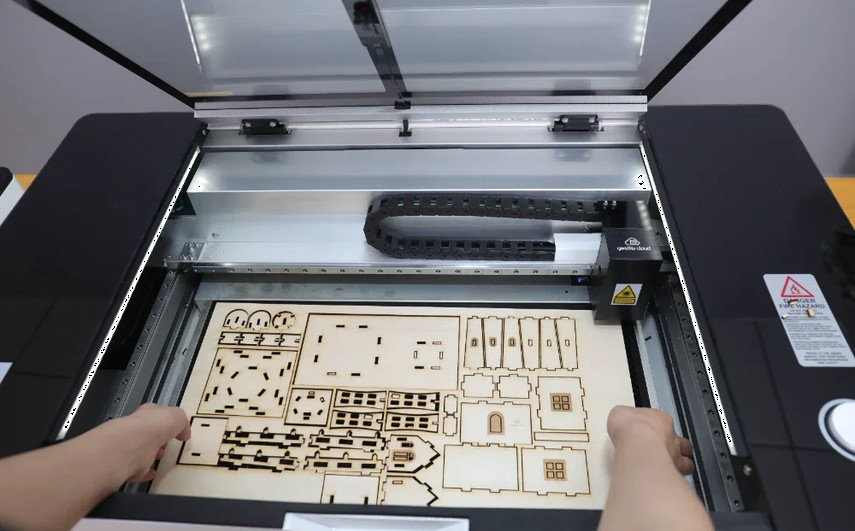
In the furniture and craft industries, CO2 lasers are used for detailed engraving on plywood, MDF, and hardwoods. The ability to control depth and contrast allows for intricate designs that CNC routers cannot achieve. A 80W-100W machine is typically sufficient for engraving, while 130W+ is recommended for cutting thicker plywood. Proper ventilation systems are crucial to handle the smoke and particulates generated during wood processing, a feature standard in MeykoLaser’s industrial enclosures.
Textiles and Leather Goods
The fashion and automotive interior industries rely on CO2 lasers for cutting fabric and engraving leather. Unlike mechanical cutting, laser cutting seals the edges of synthetic fabrics, preventing fraying. For leather goods, the laser can engrave serial numbers, logos, or decorative patterns without touching the material, eliminating tool wear. MeykoLaser offers specialized low-power settings for delicate materials, ensuring precise control over burn depth to avoid damaging underlying layers.
Total Cost of Ownership vs. Initial Price
Procurement managers must look beyond the sticker price. The CO2 engraving machine price is just the entry point. A cheaper machine may have higher maintenance costs, lower reliability, and shorter component lifespans. MeykoLaser emphasizes transparency in pricing and provides detailed lifecycle cost analyses. For example, our high-efficiency laser tubes consume less electricity and require fewer replacements over a five-year period compared to generic brands. Furthermore, our global service network ensures minimal downtime, which is critical for maintaining production schedules in just-in-time manufacturing environments.
Data from industry benchmarks indicates that machines with higher initial investment in precision mechanics and quality laser sources demonstrate a 30-40% lower cost per part over their lifespan due to reduced scrap rates and maintenance interventions. By choosing MeykoLaser, buyers invest in a system designed for longevity and consistent performance, rather than a disposable tool.
How to Select the Right CO2 Laser for Your Business
Selecting the optimal equipment requires a thorough assessment of your production needs. Consider the following steps:
- Material Analysis: Identify the primary materials you will process. If you work predominantly with metals, a fiber laser is more appropriate. If your focus is on non-metals, CO2 is the correct choice.
- Volume and Speed: Estimate your daily throughput. High-volume operations benefit from higher power and faster galvo systems, justifying a higher CO2 engraving machine price.
- Workspace Constraints: Measure your available floor space and ensure the machine’s dimensions, including ventilation requirements, fit your facility.
- After-Sales Support: Verify the manufacturer’s warranty terms and availability of spare parts. MeykoLaser provides comprehensive training and remote technical support to ensure rapid troubleshooting.
By carefully evaluating these factors, businesses can make informed decisions that align with their strategic goals. MeykoLaser is committed to providing tailored solutions that maximize efficiency and profitability for our global partners.
Conclusion
The CO2 engraving machine price is a reflection of the technology’s capability, precision, and longevity. For B2B buyers in the manufacturing sector, investing in a high-quality CO2 laser system from a trusted provider like MeykoLaser ensures superior product quality, operational efficiency, and a strong return on investment. As industries continue to demand greater customization and speed, the versatility of CO2 laser technology remains unmatched for non-metal applications.
Frequently Asked Questions
What is the average price range for an industrial CO2 engraving machine?
The price range for industrial CO2 engraving machines typically varies from $5,000 to $25,000 USD, depending on power output, working area, and automation features. Entry-level units with 60W power and smaller beds are on the lower end, while high-power 150W+ machines with RAYLASE galvo systems and large-format beds command higher prices. At MeykoLaser, we offer transparent pricing based on specific configuration needs, ensuring you pay for the precision and durability required for your production volume.
Does a higher CO2 laser power always mean a higher price?
Generally, yes. Higher power outputs (e.g., 130W vs. 80W) require more expensive laser tubes, cooling systems, and electrical components. However, higher power also significantly increases cutting speed and engraving depth, which can improve your return on investment through faster throughput. MeykoLaser helps buyers calculate the cost-per-part to determine if the higher upfront price of a more powerful machine is justified by increased production efficiency.
What are the main differences between CO2 and fiber laser pricing?
CO2 lasers are typically priced lower than fiber lasers of comparable power because the technology is mature and less expensive to manufacture for non-metal applications. However, fiber lasers are more efficient for metals and have lower operating costs for metal processing. If your primary materials are wood, acrylic, leather, or fabric, a CO2 laser offers better performance and a more favorable price-to-performance ratio than a fiber laser.
How does maintenance cost affect the total cost of a CO2 engraving machine?
Maintenance costs include laser tube replacement, mirror cleaning, and lubrication. High-quality machines from MeykoLaser use sealed, long-life laser tubes that last over 10,000 hours, reducing the frequency of replacements. Additionally, robust mechanical components require less frequent calibration and part replacement. While cheaper machines may have a lower initial price, their higher maintenance frequency and downtime can lead to a higher total cost of ownership over five years.
Can I get a custom quote for a CO2 engraving machine from MeykoLaser?
Yes, MeykoLaser provides customized quotes based on your specific production requirements, including material types, desired engraving speed, and work area dimensions. Our sales team conducts a thorough needs analysis to recommend the optimal configuration, ensuring you receive the best value for your investment. Contact us directly through our website to discuss your project and receive a detailed proposal tailored to your business needs.