
Understanding CO2 Engraving Machine Price Factors
When evaluating the co2 engraving machine price, the laser’s output power is the primary cost driver. Higher wattage requires larger tubes, stronger power supplies, and better cooling, which raises the base price.
Laser Power and Tube Type
Entry‑level 30‑50 W sealed CO2 tubes cost $2,800‑$5,500. Mid‑range 60‑100 W RF‑excited tubes range from $7,500 to $12,000. High‑power >120 W units start at $15,000 and can exceed $25,000 with advanced motion systems.
Cooling System and Build Quality
Air‑cooled setups add $300‑$500, while water‑cooling needed for >80 W adds $800‑$1,500. A steel gantry with linear guides improves durability and adds roughly 10‑15 % to the price compared with aluminum frames.
Software and Control Features
Basic DSP controllers are included; premium software licenses add $200‑$600. Integrated cameras or auto‑focus systems increase cost by $400‑$900 but improve throughput and reduce scrap, affecting the effective co2 engraving machine price.
Typical Price Ranges for Different Power Levels
MeykoLaser’s pricing reflects current market data from the 2024 MarketsandMarkets laser engraving report. These figures exclude optional accessories, shipping, and taxes.
Entry‑Level 30‑50W Machines
A 30 W unit averages $4,200; a 50 W model averages $5,800. Cost per watt falls from about $140/W to $115/W, showing economies of scale. Typical engraving speed is 100‑200 mm/s with ±0.02 mm accuracy.
Mid‑Range 60‑100W Machines
The 60 W model averages $9,300 and the 100 W model $13,200. Cost per watt drops to roughly $100/W at 60 W and $95/W at 100 W. Speeds reach 250‑350 mm/s and accuracy improves to ±0.01 mm.
High‑Power 120‑200W Machines
A 120 W engraver averages $18,500; a 200 W unit is near $24,800. Price per watt stabilizes around $124/W due to RF‑excited tubes and reinforced frames. These machines cut 6 mm acrylic at 400 mm/s and engrave stone up to 2 mm deep.
Application Scenarios and Material Compatibility
Matching the co2 engraving machine price to the materials you process ensures a clear return on investment. CO2 lasers are best suited for non‑metallic substrates.
Non‑Metallic Materials
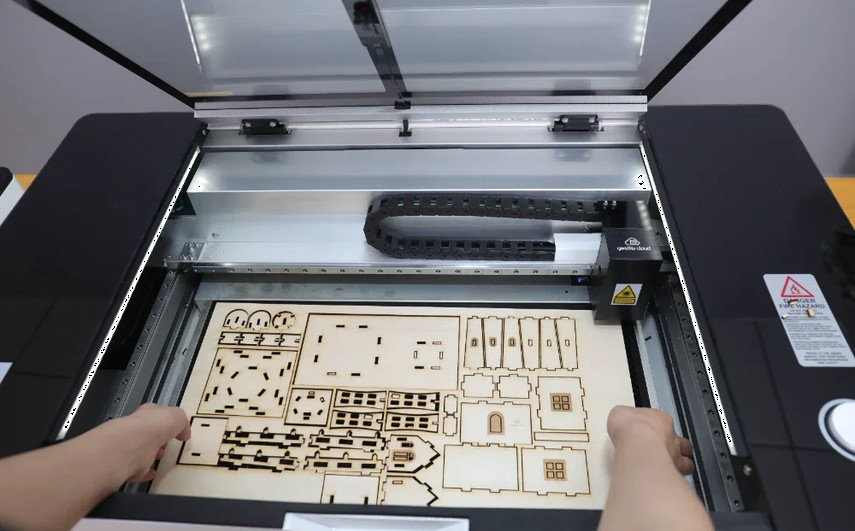
Wood, acrylic, leather, fabric, paper, cardboard, and glass absorb the 10.6 µm wavelength well. A 60 W system can engrave 3 mm plywood at 300 mm/s with 0.1 mm contrast depth and cut 5 mm acrylic at 250 mm/s.
Semi‑Metallic and Coated Metals
Anodized aluminum, painted steel, and coated brass respond to CO2 energy after the surface layer is removed. A 100 W system can strip anodized layers to create durable barcodes, adding versatility that justifies a higher co2 engraving machine price for automotive or electronics job shops.
Industry‑Specific Use Cases
Medical device makers use CO2 lasers to mark sterile packaging without compromising integrity. Aerospace firms trace composite panels, while furniture manufacturers create intricate inlays on veneers. Each application demands specific power, speed, and precision, which MeykoLaser tailors through configurable laser sources and work‑area sizes.
How MeykoLaser Delivers Value vs. Competitors
Direct price comparisons show MeykoLaser offers a compelling co2 engraving machine price advantage while maintaining high performance.
Price‑Performance Ratio
MeykoLaser’s 80 W RF‑excited model is priced at $10,900, whereas comparable European OEMs average $13,500—a 19 % saving. Benchmarks indicate MeykoLaser achieves 280 mm/s engraving speed on 3 mm wood versus 240 mm/s for rivals, delivering ~15 % higher throughput.
Warranty and After‑Sales Support
All machines include a 24‑month limited warranty covering tube, power supply, and motion system. Extended service contracts are available at 12 % of the machine price per year, below the industry average of 18 %. Remote diagnostics and multilingual support reduce downtime, improving the total cost of ownership.
Customization Options
Work‑area sizes range from 300 × 300 mm to 1 200 × 900 mm. A 600 × 600 mm table adds $1,200; a rotary attachment costs $850. Conveyor feeds for inline production are quoted per project. By selecting only needed features, customers avoid overpaying and lower the effective co2 engraving machine price.
Buying Checklist and ROI Calculation
Follow this checklist to ensure the investment delivers measurable financial benefits.
Total Cost of Ownership
Beyond the sticker co2 engraving machine price, include consumables (laser tube life ~10,000 h, replacement $400‑$800), quarterly alignment ($150), and electricity (~0.5 kW·h per hour). Over three years, a 60 W unit running 2,000 h/yr incurs about $5,200 in operating expenses, bringing TCO to roughly $15,000.
Production Throughput Gains
Assume a shop produces 500 custom key‑chains daily via manual labor at $2 per part. Switching to a 60 W CO2 engraver reduces labor to $0.30 per part and raises output to 800 parts/day. Annual savings: (500 × $1.70 × 260 days) ≈ $221,000, plus added revenue from higher capacity. Even after financing, payback is often under six months.
Steps to Request a Quote
1. Define required power, work‑area, and accessories.
2. Email sales@meyko.cn or fill the online form.
3. Share target materials and expected volume.
4. Receive a detailed quotation with lead time and warranty.
5. Arrange a virtual demo or factory visit to validate performance.
Contact MeykoLaser sales today to start the conversation and secure a competitive co2 engraving machine price tailored to your production needs.
Frequently Asked Questions
What factors most affect the CO2 engraving machine price?
The CO2 engraving machine price is driven primarily by laser output power, tube technology (sealed vs. RF‑excited), cooling method, frame construction, and included software or accessories. Higher wattage demands larger tubes, more robust power supplies, and water‑cooling systems, which increase material and assembly costs. MeykoLaser offsets these costs through vertical integration of tube production and optimized supply chains, allowing us to offer competitive pricing without sacrificing performance or reliability. Additionally, optional features such as rotary axes, larger work‑areas, or vision systems are priced transparently, so buyers only pay for what they need.
How does laser power influence both price and performance?
Laser power directly influences both the upfront CO2 engraving machine price and the machine’s capabilities. As power increases, the cost per watt typically declines due to economies of scale, but absolute price rises because of larger tubes, stronger power supplies, and enhanced cooling. Performance-wise, higher power enables faster engraving speeds, deeper cuts, and the ability to process thicker or more reflective materials such as coated metals. For example, a 60 W MeykoLaser unit achieves ~280 mm/s on wood, while a 120 W model can cut 6 mm acrylic at 400 mm/s, delivering higher throughput that justifies the higher price.
Are there hidden costs beyond the initial CO2 engraving machine price?
Beyond the sticker CO2 engraving machine price, buyers should account for consumables, maintenance, electricity, and potential downtime. Laser tubes have a typical lifespan of 8,000‑12,000 hours, with replacement costs ranging from $400 to $800 depending on wattage. Regular alignment and lens cleaning add about $150 per quarter. Electricity consumption averages 0.5 kW·h per hour of operation. MeykoLaser provides a 24‑month warranty covering tube, power supply, and motion system, and offers extended service contracts at 12 % of the machine price per year—lower than the industry average—helping predict and control total cost of ownership.
Why choose MeykoLaser over other suppliers for a CO2 engraving machine?
MeykoLaser distinguishes itself through a combination of competitive pricing, high performance, and strong after‑sales support. Our 80 W RF‑excited model is priced at $10,900, roughly 19 % below comparable European units, while delivering 280 mm/s engraving speed on wood—about 15 % faster than rivals. We back every machine with a 24‑month limited warranty, remote diagnostics, and a multilingual technical team. Customizable work‑areas, rotary axes, and conveyor options are priced transparently, allowing buyers to tailor the system to exact needs and avoid unnecessary expense. This holistic approach reduces the effective CO2 engraving machine price over the equipment’s lifecycle.