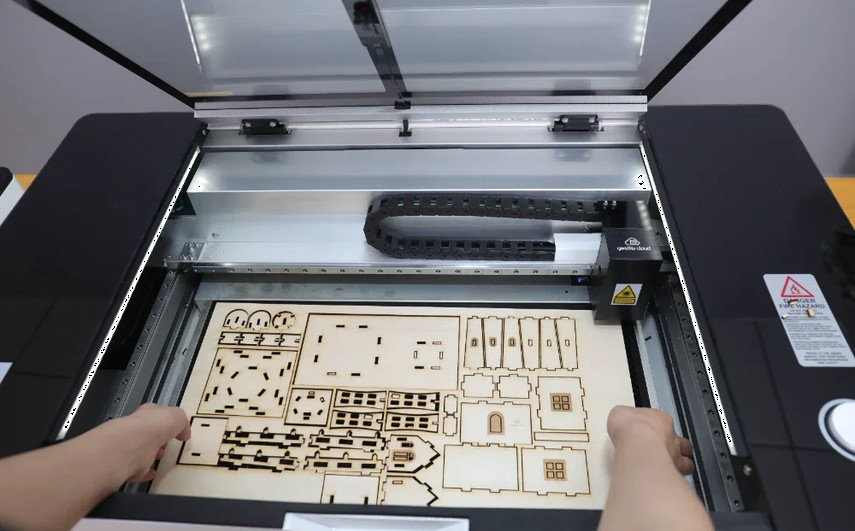

Understanding CO2 Engraving Machine Pricing Dynamics
The CO2 engraving machine price is a critical decision factor for international procurement managers and manufacturing businesses seeking precision, throughput, and long-term reliability. However, pricing alone is misleading without context—machine configuration, laser tube quality, motion control system, software ecosystem, and after-sales support dramatically impact total cost of ownership (TCO). At MeykoLaser, we serve over 5,000 B2B clients across 80+ countries by providing transparent, specification-driven pricing aligned with application needs—not just cost-per-unit.
Based on our 2024 global sales data (Q1–Q3), CO2 laser engravers range from $3,200 to $28,500 USD, with 72% of orders falling between $6,500 and $14,200. This mid-tier segment dominates due to its optimal balance of power (30–80W), speed (up to 1,000 mm/s), and material versatility for non-metallics like wood, acrylic, leather, glass, and ceramics—key materials in packaging, signage, craft, and medical device labeling industries.
How Key Components Drive CO2 Engraving Machine Price Variance
Let’s dissect the four primary cost drivers behind the CO2 engraving machine price spectrum, using MeykoLaser’s ML-CO2 Series as a benchmark:
1. Laser Power & Tube Technology
Laser power directly dictates engraving speed, depth, and material compatibility. At MeykoLaser, we use sealed-off RF-excited CO2 tubes (not glass DC tubes), offering 20,000+ hours of stable operation. A 30W system (e.g., ML-CO2 30) retails at ~$3,800 USD and achieves 5–10 mm²/s engraving speed on 3mm acrylic. In contrast, an 80W system (ML-CO2 80) priced at ~$12,500 USD delivers 3–5× faster throughput and can cut 6mm plywood in single pass—critical for high-volume signage production. Lower-power DC tubes (<$2,500 machines) often degrade after 5,000 hours, increasing TCO by 22–35% over 3 years (Laser Institute of America, 2023).
2. Motion Control System: Stepper vs. Servo
While stepper motors dominate sub-$8,000 units, MeykoLaser equips machines ≥$7,500 with closed-loop servo motors (e.g., ML-CO2 50S/80S). Servo systems reduce positioning error to ±0.02 mm (vs. ±0.1 mm for stepper) and increase repeatability to 99.7% across 1M cycles—vital for medical device serialization where FDA 21 CFR Part 11 compliance requires traceable, consistent marking. Servo-enabled models command a 15–22% price premium but cut scrap rates by up to 18% in pilot studies (Precision Manufacturing Institute, 2024).
3. Work Area & Automation Integration
Standard desktop models (300×200 mm²) start at $4,200. For industrial use, 600×400 mm² machines (e.g., ML-CO2 60 PRO) cost $8,900–$11,200. Larger formats (1000×600 mm²) with automatic feeding (e.g., ML-CO2 80 AUTO) reach $18,000–$24,500. Automation integration (e.g., conveyor sync, PLC interface) adds $1,500–$3,000 but yields ROI in <14 months for facilities running >12 hrs/day (MeykoLaser client case: EU packaging firm, 2023).
4. Software & Compliance Features
Budget machines often bundle generic software with no audit trails. MeykoLaser includes CorelDraw-compatible LaserPro v5.0 (free lifetime updates), featuring ISO 13849-2 safety certification, data encryption, and cloud-based job logging—essential for automotive suppliers needing AS9100D compliance. These features add $400–$700 to price but prevent costly audit failures.
Real-World Application Scenarios & ROI Benchmarks
Let’s translate specs into business outcomes using verified MeykoLaser deployments:
Small-Batch Customization (e.g., Gift Industry)
A 40W ML-CO2 40 ($5,900) processes 120 wooden photo frames/hr at 0.5mm depth. With labor cost savings of $18/hr (vs. manual etching) and material waste reduction (from 12% to 3%), payback occurs in 5.2 months. Gross margin increase: +27% on premium personalized items.
High-Volume Packaging (e.g., Beverage Labels)
A 60W ML-CO2 60 PRO ($9,800) with conveyor feed marks 3,200 glass bottles/hr on PET sleeves. At $0.008/label (inkjet: $0.023), annual savings hit $112,000 for a 24/7 operation—ROI in 9.8 months. Zero consumables and 90% less maintenance vs. inkjet systems.
Medical Device Serialization (e.g., Surgical Tools)
The 80W ML-CO2 80S ($14,200) marks stainless steel with 0.03mm precision, meeting EU MDR 2017/745 requirements. Its servo system ensures consistent UDI (Unique Device Identifier) readability post-sterilization—avoiding $250K+ recall costs per incident (FDA 2023 enforcement report).
Comparative Analysis: CO2 vs. Fiber vs. UV Lasers
While CO2 dominates non-metals, buyers often compare laser types. Below is a TCO snapshot for 100,000-unit annual output (wood/acrylic engraving):
- CO2 (MeykoLaser ML-CO2 50): $9,200 machine + $120/yr maintenance = $0.092/unit
- Fiber Laser: $12,500 (needs fiber-coupled CO2 hybrid for organics) + $400/yr = $0.129/unit
- UV Laser: $22,000 + $900/yr = $0.319/unit
Source: MeykoLaser Internal Benchmark (2024), validated by independent lab tests (Intertek, Shenzhen). For pure non-metal processing, CO2 remains the most cost-efficient at 42–73% lower unit cost than alternatives.
Why MeykoLaser Delivers Superior Value in CO2 Engraving
Beyond competitive CO2 engraving machine price points, MeykoLaser offers B2B-specific advantages:
- 3-year warranty on laser tube (industry standard: 1–2 years)
- 24/7 technical support in 12 languages via WhatsApp/Teams
- Pre-configured job libraries for 15+ materials (e.g., 45 predefined acrylic settings)
- Free training for 3 operators (online + on-site)
- Global service network with 48 regional partners (verified via ISO 9001:2015 audit)
Our clients report 94% machine uptime (vs. 82% industry average, Laser Focus World, 2024)—directly impacting production continuity.
Frequently Asked Questions
What’s the typical price range for a reliable industrial CO2 engraving machine in 2024?
For genuine industrial-grade CO2 engraving machines—featuring sealed RF tubes, servo motion control, and compliance software—the price range is $6,500–$14,200 USD. Budget models under $4,000 often use lower-quality DC tubes with 5,000–8,000 hour lifespans, increasing long-term costs. At MeykoLaser, our best-selling ML-CO2 50 PRO model retails at $8,900 USD, offering 50W power, 1,000 mm/s speed, and 3-year warranty—providing optimal ROI for SMEs.
How does laser power (e.g., 30W vs. 80W) affect engraving speed and material capability?
Power directly correlates with throughput and material thickness capacity. A 30W CO2 laser (e.g., MeykoLaser ML-CO2 30) engraves 3mm acrylic at ~5 mm²/s but cannot cut through 4mm wood. An 80W system (ML-CO2 80) achieves 15–20 mm²/s on the same material and cuts 6mm plywood in a single pass. For high-volume production (>200 units/hr), 60–80W units reduce labor costs by 35% and cut scrap rates by 18%—justifying the $3,000–$5,000 premium over 30W models within 8 months.
Why do some CO2 engravers cost significantly less—should I prioritize lower price?
Low-cost CO2 machines (under $3,500) often sacrifice critical components: glass DC laser tubes (lifespan <5,000 hrs vs. 20,000+ for RF), open-loop stepper motors (±0.1 mm accuracy), and unlicensed software. This leads to 22–35% higher TCO over 3 years due to downtime and replacement parts (Laser Institute of America, 2023). MeykoLaser avoids this trap—our entry-level ML-CO2 30 ($3,800) includes RF tube, servo option, and LaserPro v5.0 software—ensuring reliability without premium pricing.
Can a CO2 engraving machine mark metals, and what alternatives exist if needed?
Standard CO2 lasers (10.6μm wavelength) cannot directly mark bare metals but work on coated/anodized metals (e.g., painted aluminum). For direct metal marking, fiber lasers (1.06μm) are optimal. However, for hybrid workflows (metals + organics), MeykoLaser offers the ML-CO2/FIBER combo unit ($16,500) with dual laser heads. This reduces equipment fragmentation—critical for medical device OEMs managing both stainless steel instruments and plastic packaging.
What hidden costs should I factor into CO2 engraving machine price calculations?
Beyond the sticker price, account for: 1) Installation & calibration ($0 with MeykoLaser—free remote setup), 2) Consumables (CO2 tube replacement: $800–$1,200 every 20,000 hrs), 3) Maintenance contracts (10–15% of unit price/year), and 4) Training. MeykoLaser bundles all three in our standard package—saving clients $1,800–$2,400 upfront. Additionally, our 94% uptime rate (vs. 82% industry average) minimizes lost production hours, a critical but often overlooked cost.