
Understanding the True Cost of CO2 Engraving Machines in 2024
For procurement managers and manufacturing directors, the CO2 engraving machine price is rarely a single fixed number. It is a complex variable determined by tube type, galvanometer speed, laser source longevity, and integrated software ecosystems. In the current global market, understanding the correlation between initial capital expenditure (CapEx) and long-term operational expenditure (OpEx) is critical for maintaining competitive margins. While entry-level units may appear attractive at first glance, they often lack the precision and throughput required for high-volume industrial applications. MeykoLaser provides a transparent breakdown of these costs, helping B2B buyers make data-driven decisions that align with their production goals.
Key Factors Influencing CO2 Engraving Machine Pricing
When analyzing the CO2 engraving machine price, several technical specifications drive the final quotation. The laser source itself accounts for approximately 40-50% of the total machine cost. Below is a detailed comparison of how different configurations impact pricing and performance.
Laser Source Technology: Glass vs. RF vs. Metal Tube
The choice of laser source is the primary determinant of both price and durability. Traditional glass CO2 tubes are the most affordable option, with initial costs ranging from $2,000 to $5,000 for the source alone. However, these tubes have a short lifespan, typically lasting only 1,000 to 2,000 hours before requiring replacement. This results in high OpEx due to frequent downtime and part replacement costs.
RF CO2 laser sources, while having a higher upfront cost ranging from $8,000 to $15,000, offer a lifespan of 10,000 to 20,000 hours. For high-volume manufacturing environments, the total cost of ownership (TCO) for RF sources is significantly lower than glass tubes. MeykoLaser recommends RF sources for heavy-duty industrial applications to minimize maintenance interruptions. Metal CO2 tubes offer a middle ground, providing higher power stability than glass tubes at a moderate price point, suitable for medium-volume production lines.
Galvanometer Scanner Quality and Speed
The marking head, specifically the galvanometer scanner, affects both precision and speed. High-end scanners from brands like Raycus or JPT (adapted for CO2 systems) or specialized RF scanners offer faster marking speeds, ranging from 4,000 to 7,000 characters per second. These units command a premium of $1,500 to $3,000 over standard Chinese-made scanners. However, the increase in throughput can justify the investment by reducing cycle times per unit. For procurement managers, calculating the cost per mark is more important than the machine's base price.
Software Integration and Automation Compatibility
Modern industrial workflows require seamless integration with ERP systems and automated material handling. Machines equipped with advanced software suites, such as MeykoLaser’s proprietary EZCAD-compatible modules or third-party integrations like CorelDRAW and AutoCAD plugins, often carry a higher price tag. Additionally, the inclusion of rotary attachments, conveyor systems, or vision positioning systems adds $500 to $3,000 to the base cost but enables fully automated, lights-out manufacturing capabilities.
Application Scenarios and Material Compatibility
Selecting the right CO2 engraving machine price point depends heavily on the materials you intend to process. CO2 lasers operate at a wavelength of 10.6 micrometers, which is highly absorbed by organic materials. This makes them ideal for non-metal applications.
Wood and Acrylic Processing
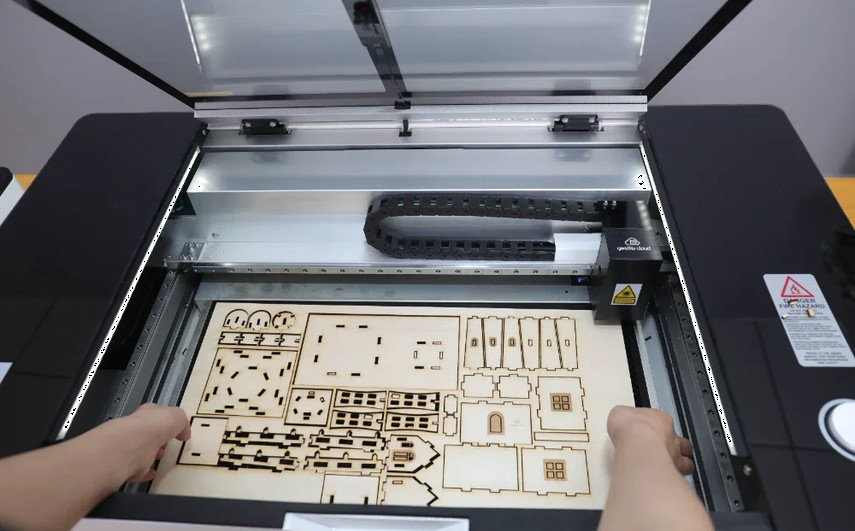
In the signage and packaging industries, CO2 lasers are the gold standard for cutting and engraving wood, MDF, and acrylic. A 60W to 100W CO2 laser can achieve deep engraving in hardwoods and clean edge polishing in acrylics. The precision required here often dictates the need for higher-quality optical lenses and stable power supplies, influencing the machine's price range between $4,000 and $8,000 for industrial-grade units.
Leather and Textile Marking
The fashion and automotive interior sectors utilize CO2 lasers for precision marking on leather, suede, and synthetic fabrics. The ability to create intricate patterns without physical contact prevents material distortion. For these applications, variable power control is essential to prevent burning delicate materials. MeykoLaser’s industrial CO2 systems offer precise power modulation, ensuring consistent quality across large batches of leather goods.
Packaging and Paper Products
For corrugated cardboard and paper packaging, high-speed CO2 lasers are used for serializing and coding. The focus here is on speed and reliability rather than deep engraving. A 50W to 80W system with a high-speed galvanometer is typically sufficient, keeping the investment in the $3,500 to $6,000 range.
Comparative Analysis: CO2 vs. Fiber for Industrial Marking
While the focus of this guide is on CO2 systems, it is crucial for B2B buyers to understand when CO2 is the superior choice over fiber lasers. Fiber lasers are dominant in metal marking but are generally ineffective on non-metals. If your primary materials are plastics, wood, glass, or ceramics, a CO2 system is the only viable option. The CO2 engraving machine price is often comparable to entry-level fiber systems, but the operational efficiency on non-metallic substrates is unmatched. For mixed-material workshops, MeykoLaser suggests evaluating the volume of non-metal work; if it exceeds 30% of total throughput, a dedicated CO2 machine is a necessary investment.
Maximizing ROI with MeykoLaser Industrial Solutions
MeykoLaser distinguishes itself by offering transparent pricing structures that reflect true industrial value. Our machines are engineered for 24/7 operation, featuring advanced cooling systems and high-quality optics that reduce energy consumption by up to 20% compared to older models. By investing in a MeykoLaser CO2 system, buyers gain access to comprehensive after-sales support, including remote diagnostics and guaranteed spare parts availability. This reduces the risk of extended downtime, which is often the most costly factor in laser processing operations.
Customization for Specific Industry Needs
We understand that no two manufacturing lines are identical. MeykoLaser offers customized solutions, including specialized worktables, fume extraction units, and safety enclosures. These customizations ensure compliance with local safety regulations and optimize workflow efficiency. Our team works directly with procurement managers to tailor the machine specifications to exact production requirements, ensuring that every dollar spent contributes directly to operational efficiency.
Frequently Asked Questions
What is the average price range for an industrial CO2 engraving machine?
The average price range for an industrial-grade CO2 engraving machine typically falls between $4,000 and $12,000 USD, depending on the laser source type and power output. Entry-level glass tube systems with 50W-80W power usually start around $4,000 to $6,000. Mid-range systems featuring RF or high-end metal tubes, offering higher stability and longer lifespans, range from $7,000 to $10,000. Premium systems with advanced automation, large bed sizes, and integrated vision systems can exceed $12,000. It is important to consider the total cost of ownership, including maintenance and energy consumption, rather than just the initial purchase price.
How does the laser source type affect the long-term cost of a CO2 machine?
The laser source is the most critical component affecting long-term costs. Glass CO2 tubes are cheaper upfront but have a lifespan of only 1,000-2,000 hours, requiring frequent and costly replacements. In contrast, RF CO2 sources, while more expensive initially, last 10,000-20,000 hours and maintain consistent power output over time. This reduces downtime and maintenance labor costs. For high-volume production, the higher initial investment in an RF source pays for itself within the first year through reduced operational disruptions and lower part replacement frequency.
Can I use a CO2 laser machine for marking metals?
Standard CO2 lasers cannot directly mark most bare metals because their 10.6-micrometer wavelength is not well-absorbed by metallic surfaces. However, CO2 lasers can be used to mark metals if a marking compound or coating is applied to the surface first, which then burns off to create a contrast. For direct metal marking, fiber lasers are the industry standard. If your workflow involves mostly non-metals with occasional metal marking needs, using a marking compound with a CO2 machine can be a cost-effective solution, but for dedicated metal work, a fiber laser is recommended.
What maintenance is required for a CO2 engraving machine?
Regular maintenance is essential to ensure the longevity and performance of your CO2 engraving machine. Key tasks include cleaning the optical lenses and mirrors every 50-100 hours of operation to prevent dust accumulation, which can damage the optics. The water cooling system requires regular water changes and cleaning of the chiller filters to maintain optimal temperature control. Additionally, aligning the laser beam path should be checked periodically, especially after moving the machine. MeykoLaser provides detailed maintenance schedules and offers remote support to help your team perform these tasks efficiently, minimizing downtime.
How do I choose the right power wattage for my application?
Choosing the correct wattage depends on the thickness and type of material you are processing. For thin materials like paper, thin acrylic, and leather, 30W-50W is sufficient for engraving and light cutting. For thicker woods, acrylics, and dense plastics, 60W-100W provides better cutting speed and deeper engraving capabilities. If you require cutting through thick materials (over 10mm) or high-speed production, 100W+ systems are necessary. MeykoLaser’s technical team can assess your specific material requirements and recommend the optimal wattage to balance cost and performance, ensuring you do not overpay for unused power capacity.
Contact MeykoLaser for a Customized Quote
Investing in the right CO2 engraving machine price is a strategic decision that impacts your manufacturing efficiency and profitability. At MeykoLaser, we are committed to providing transparent, competitive pricing and high-quality industrial solutions tailored to your specific needs. Our team of experts is ready to assist you in selecting the perfect machine for your production line. Contact us today at www.meyko.cn to request a personalized quotation and discuss how we can help optimize your laser processing operations.
TAG: