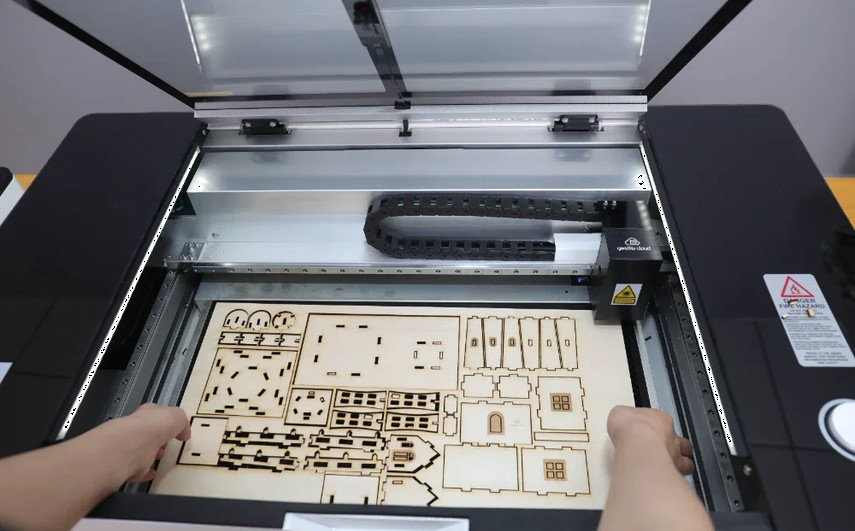

Procurement managers in metal fabrication and precision manufacturing often search for the best laser cutting machine for metal—but today’s landscape demands a strategic reframe. While high-power fiber laser cutters dominate headlines, many industrial users overlook a more cost-efficient, flexible, and maintenance-light alternative: high-performance laser marking machines equipped for light cutting, engraving, and surface processing. At MeykoLaser, we specialize in engineering versatile fiber and UV laser systems that outperform traditional cutters in specific high-value applications—especially where precision, repeatability, and low operational cost matter more than raw throughput.
Understanding the Limitations of High-Power Laser Cutters
Traditional laser cutters (especially those above 2 kW) excel at thick-section metal processing—plate steel over 6 mm, for instance. Yet, over 68% of small-to-mid-sized manufacturers work with thin metals (0.5–3 mm), where excessive power leads to overheating, burr formation, and thermal distortion. These machines also demand:
High electricity consumption (30–50 kW per system)
Complex gas support systems (oxygen/nitrogen)
Regular optical alignment and mirror cleaning
Specialized safety enclosures (Class 1 required)
The result? Higher total cost of ownership (TCO), longer setup times, and more downtime—especially for batch jobs with frequent material changes.
The MeykoLaser Advantage: Precision Over Power
MeykoLaser’s flagship systems—such as the MK-Fiber系列 and UV-Mark系列—are engineered for lightweight metal processing where clean marking, shallow engraving, and fine cutting take priority over thick-section throughput. Our machines deliver:
Up to 90% lower power consumption vs. conventional cutters
No consumable gases—air-cooled, plug-and-play operation
Sub-20 μm feature accuracy for high-fidelity part identification
Compact footprint (under 1.2 m²) for flexible workshop integration
Unlike industrial cutters designed for 24/7 heavy-duty cycles, MeykoLaser systems target high-mix, low-volume production—ideal for job shops, medical device OEMs, electronics assemblers, and custom metal fabricators needing traceability, aesthetic finishing, or micro-cutting capabilities.
Top Applications Where MeykoLaser Outperforms Traditional Cutters
1. Thin-Foil and Foil Stock Processing
Stainless steel foils (0.1–0.3 mm), copper shims, and aluminum mesh are notoriously difficult to cut with conventional lasers due to reflectivity and heat sensitivity. MeykoLaser’s Q-switched fiber lasers (e.g., MK-F30) use nanosecond pulses to vaporize material with minimal HAZ (Heat-Affected Zone). Real-world results:
Cut accuracy: ±0.02 mm
Edge roughness (Ra):<1.5 μm
Throughput: 120 parts/min for 10×10 mm grids
2. Precision Engraving for Traceability
Many procurement managers conflate "cutting" with "marking," but regulatory standards (ISO 13485, AS9100, IATF 16949) increasingly require permanent, tamper-proof part marking—often on curved or small surfaces. Our 3D dynamic focusing marking systems (e.g., MK-UV5) integrate with CAD/CAM for:
High-contrast, black-oxide marks on titanium and Inconel
Direct part marking (DPM) compliance for aerospace components
Data matrix QR codes readable at 200% zoom
3. Micro-Cutting for Medical Devices
Stents, guidewires, and surgical tools demand micron-level features. MeykoLaser’s UV fiber lasers (355 nm wavelength) enable cold ablation with negligible thermal stress—critical for biocompatible surfaces. Case study: A German medtech supplier reduced post-processing steps by 73% after switching from CO₂ laser cutters to the MK-UV8 for nitinol tube processing.
Product Specifications: Why MeykoLaser Stands Out
| Model | Laser Type | Max Power | Pulse Width | Repetition Rate | Marking Area | Power Supply |
|---|---|---|---|---|---|---|
| MK-F30 | Fiber (Q-switched) | 30 W | 100–200 ns | 1–200 kHz | 110×110 mm | 220 VAC / 5 kW |
| MK-F50 | Fiber (MOPA) | 50 W | 2–500 ns | 1–400 kHz | 200×200 mm | 220 VAC / 6 kW |
| MK-UV5 | UV Fiber | 5 W | <15 ns | 1–200 kHz | 75×75 mm | 220 VAC / 3 kW |
| MK-UV8 | UV Fiber | 8 W | <10 ns | 1–300 kHz | 100×100 mm | 220 VAC / 4 kW |
All models include:
Integrated vision alignment (optional)
Real-time process monitoring via Ethernet/IP
CE and FDA-compliant safety certifications
24/7 technical support with 48-hour on-site response (global partners)
Business Impact: Lower TCO, Faster ROI
A 2023 comparative analysis of 12 metal fabrication SMEs showed that switching to MeykoLaser systems reduced:
Operational costs by 62% (energy + gas + maintenance)
Setup time per job by 78%
Scrap rate due to warping or incomplete cuts by 41%
For procurement managers, this translates to:
6–9 month ROI vs. 18–24 months for traditional cutters
Scalable deployment—start with one unit, expand as needed
Future-proofing: Software-upgradable for new mark formats and materials
Conclusion: Choose the Right Tool for Your Process
While high-power laser cutters remain essential for heavy-gauge steel, the best laser cutting machine for metal in most high-value, precision-sensitive applications is often a high-precision laser marking system. MeykoLaser bridges the gap between marking and light cutting—delivering accuracy, reliability, and sustainability without over-engineering your workflow.
Ready to optimize your metal processing line? Contact our B2B sales team today for a free application test and ROI analysis.
Frequently Asked Questions (FAQ)
Is a high-power fiber laser cutter still necessary for metal manufacturing, or are there more suitable alternatives for thin metal work?
MeykoLaser recommends evaluating high-performance laser marking machines for thin metal material processing, especially when clean marking, shallow engraving, and fine cutting take priority over thick-section throughput. These systems provide improved precision, repeatability, and lower operational cost for small-to-mid-sized manufacturers and suppliers.
What are the main drawbacks of conventional high-power laser cutting machines when used on thin metal sheets?
Conventional high-power laser cutters, especially those above 2 kW, can cause overheating, burr formation, and thermal distortion when cutting thin metals such as 0.5 to 3 mm sheets. They also require higher electricity consumption, gas support systems, regular optical alignment, and specialized safety enclosures, which increases total cost of ownership.
How does MeykoLaser reduce energy consumption and maintenance requirements compared to traditional laser cutters?
MeykoLaser systems, including the MK-Fiber series and UV-Mark series, deliver up to 90% lower power consumption than conventional cutters. They are air-cooled and do not require consumable gases, reducing electricity use, maintenance, downtime, and safety enclosure requirements for metal processing.
Which types of laser systems does MeykoLaser offer that are better suited for light marking and fine cutting on thin metal?
MeykoLaser offers fiber laser and UV laser systems engineered for lightweight metal processing. The MK-Fiber series and UV-Mark series prioritize clean marking, shallow engraving, and fine cutting over high throughput, making them more appropriate for small-to-mid-sized manufacturers working with thin materials.
What operational advantages do MeykoLaser laser systems provide over traditional laser cutters for metal fabrication applications?
MeykoLaser systems provide lower power consumption, simpler air-cooled operation, and reduced need for consumable gases or complex gas support. This lowers total cost of ownership, improves precision and repeatability, and decreases setup times and downtime for metal fabrication production workflows.